Blessed To Be Broken, Book Prologue
In the heart of a quaint medieval town there stood a majestic cathedral, spires reaching toward the heavens like folded hands in prayer, etched in stone. The sacred place was adorned with intricate stained-glass windows that told the stories of faith, the divine journey of the human spirit and redemption. Their kaleidoscope of colored broken glass, held together with lead and gold, was as varied as the souls of the congregation, hues bathing both during sunlit homilies.
One magnificent window depicted the story of the mustard seed, breaking open to sprout and grow into a stunning tree. Another revealed a person who lived 100 years in solitude, emerging wiser and more joyful than in youth. A grove of fruit-filled olive trees, shadowed by a withered one, seemed to embrace the elderly yet vibrant figure. Everyone had a favorite.
But there was one high above at the rear entrance to the cathedral that was different in shape and size and theme than the others. It contained many oddly shaped pieces of beautifully colored glass, recently installed after a brutal storm destroyed the one that was there for decades. Villagers came from near and far to contemplate its meaning. So many of God’s creatures were represented, from a playful grasshopper to a convocation of eagles. There were sheep, lions, camels and even a grazing ox. They all lived in harmony. At the center of the circular window was a beautiful and unusual butterfly, iridescent wings fully spread, changing its hues with sunlight and clouds. The darkness of night illuminated it as if the moon was its beacon urging it to take flight. The cocoon from which it emerged, broken shards of silk, remained as its sentinel.
Week by week people gathered beneath the window, weaving their own narratives of hope and metamorphosis. It became a focal point for contemplation and reflection. One believed the butterfly was a spiritual metaphor. The stained glass represented the imperfections of the mortal realm. It was indeed a kaleidoscope of shattered dreams, heartbreaks and moments of despair. The emergence of the butterfly symbolized the soul’s journey toward enlightenment, navigating the challenges of life, breaking free from the constraints of worldly troubles, flying to a higher state of being. But breaking free of the chrysalis seemed painful.
Another was certain the butterfly was her recently deceased husband fluttering joyfully in heaven among God’s creatures, touching the face of God. He loved butterflies. And they loved him, perching often on his shoulder and brow as he toiled the farmlands. He talked to them and he whistled to them. They would close and open their wings as if in acknowledgement of their common language and of his love for them. It brought the woman solace.
The crowd listened to each other’s stories. Some nodded in understanding, interpreting the story as a testament to the human spirit. They saw in the broken glass the trials that shaped them, molding them into stronger, wiser beings. The butterfly symbolized for some personal growth and the beauty that arises from adversity. “But how”’ one said, “could we be so broken like the stained glass and find the strength to rebuild ourselves in ways we never thought possible. What must we ask for? Who among us should ask? How will He answer?”
One day a traveler unknown to anyone of the nearby villages came to sit beneath the window. He did not speak to anyone who queried about his journey, his home. He seemed different in appearance, different in his contemplation. He appeared every day at the same time – sunrise - and stayed for seven hours. He ate the same thing every day – a small loaf of bread - and drank water from a goatskin canteen. He left the cathedral walking down a circuitous path and seemed to disappear in a cloud of dust. He visited for seven weeks. Each day the gathering at the cathedral became larger, curiosity abounding as they witnessed the magic of interpretation that unfolded within its walls. And still the mysterious pilgrim did not speak.
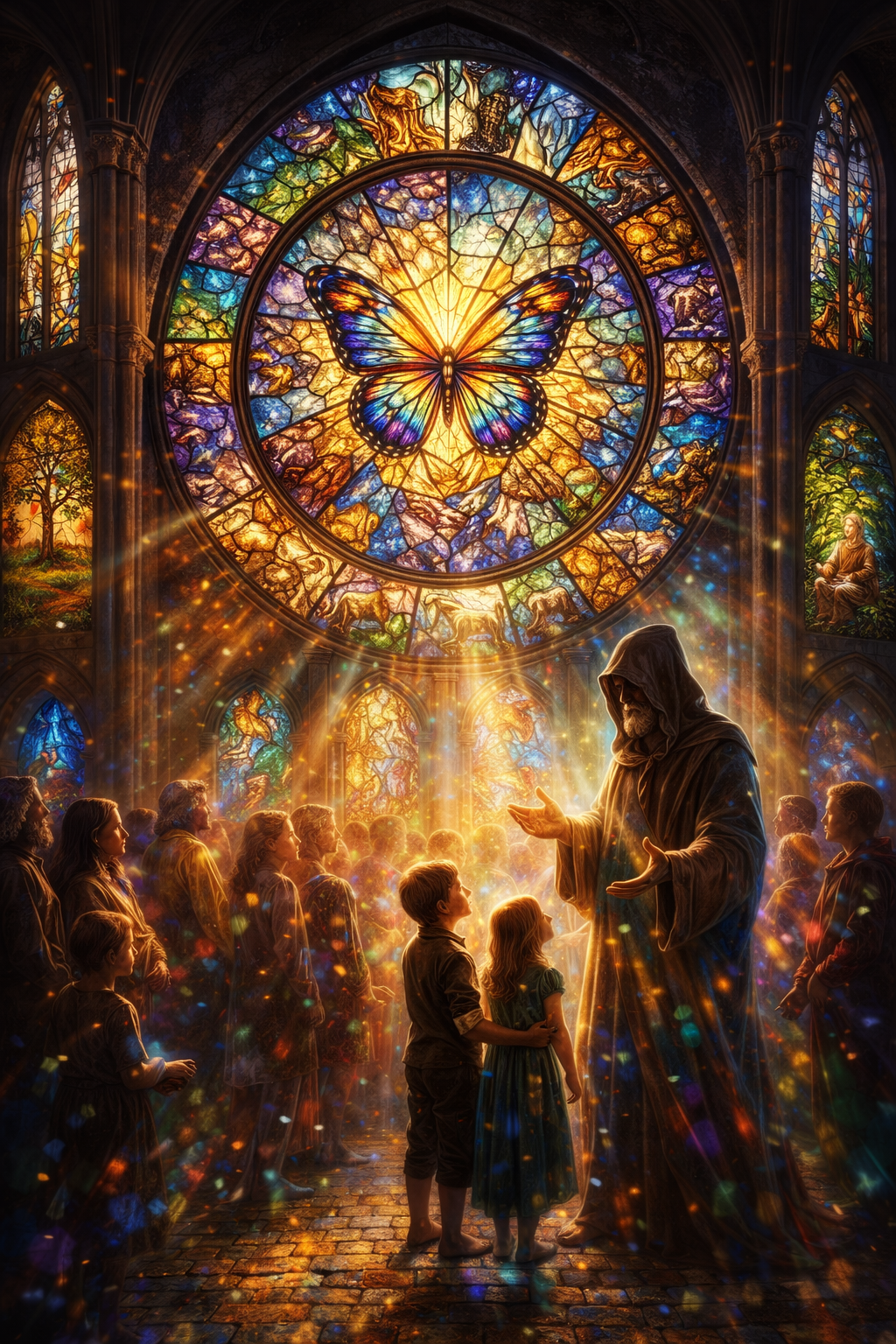
On the seventh day of the seventh week, the pilgrim arrived and sat in silence beneath the window. Two young children approached him, a girl and a boy. They asked why he would never speak, never answer their questions. He answered them in hushed tones, saying “because it was you who never asked. I, too, never heard you speak until today.” The crowd listened in awe as the children remained transfixed on the man with the outstretched hands. “Each day I have watched the elders, each day I have listened to their interpretations of the beautiful window. But you were never allowed to speak, dear children. Every person must have a voice, young and old, woman and man. Every person must share his story, must put it into the world to have meaning and purpose.”
“Your innocence, your silence, my dear children, is like the cocoon. One day you will emerge as the butterfly, shedding all of your life’s experiences. Yours will be the journey of self-discovery laden with broken dreams, broken promises, broken spirit. But it is not a journey of despair. Rather, it is a story of love. It is a story of resilience and renewal. And the echoes of forgiveness and redemption will radiate from your delicate wings. You will find yourself ‘Blessed to Be Broken.’ All, if you choose.”
Suddenly the cathedral seemed to sway in a thunderous cacophony of sound. The spires seemed heavy and then light. The ringing bells became euphonic. The pilgrim was gone. Each member of the congregation was reflected in fragmented, blinding light, their own brokenness illuminated in the intricate mosaic of the cathedral’s windows. Each of the different hues mirrored the diversity of their own life’s experiences. Each was “Blessed to Be Broken.”